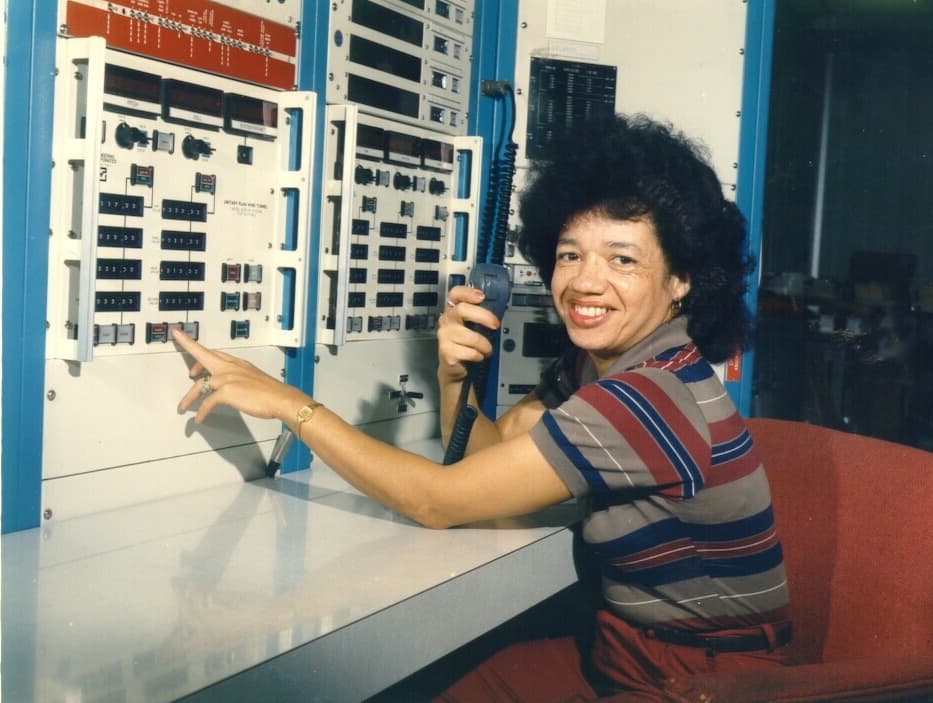
Christine Darden
b. 1942 · American
Aerospace engineering — sonic boom research
WHY YOU SHOULD KNOW THEM
Led NASA Langley's sonic boom research team; first African American woman at Langley promoted into the Senior Executive Service (1999)
THEIR STORY
Christine Darden earned a bachelor's degree in mathematics from Hampton University in 1962, a master's degree from Virginia State in 1967, and — while working full-time at NASA — a Doctor of Science in engineering from George Washington University in 1983, building her technical credentials step by step over decades rather than all at once. She joined NASA Langley Research Center in 1967, starting, like many women of her generation there, as a "computer" performing calculations by hand before being able to move into a formal engineering role. She specialized in sonic boom research — studying the shockwave a supersonic aircraft generates and how to reduce its intensity, a real and specific aerodynamic-noise problem with direct public impact, since sonic booms had already caused enough public complaint to restrict supersonic flight over land. Starting in 1989, she led the sonic boom research team under NASA's High Speed Research Program, directing the wind-tunnel testing and aerodynamic design work aimed at making a future supersonic airliner practical without the disruptive noise problem that had doomed earlier efforts. In 1999, she became the first African American woman at Langley promoted into the Senior Executive Service, the U.S. government's senior management tier for federal employees — recognition of technical leadership, not just technical work. She retired in 2007 after a nearly 40-year NASA career, having authored more than 50 aeronautical publications, and received the Congressional Gold Medal in 2019.
WHAT THEY ACTUALLY DID
As a sonic boom researcher, Darden designed and tested aircraft wing and nose configurations specifically intended to reduce the intensity of the shockwave a supersonic aircraft produces — real applied aerodynamics aimed at a measurable public-noise problem, not abstract research.
WHAT YOU'RE LEARNING THAT CONNECTS
Sonic boom research is a direct extension of the same aerodynamics fundamentals — airflow, pressure waves, aircraft shape — that students studying the four forces of flight begin learning at a simpler level.
DID YOU KNOW?
She received the Congressional Gold Medal in 2019.She authored more than 50 aeronautical publications over her nearly 40-year NASA career.
SOURCES
Wikipedia
Photo: NASA · Public domain · Source