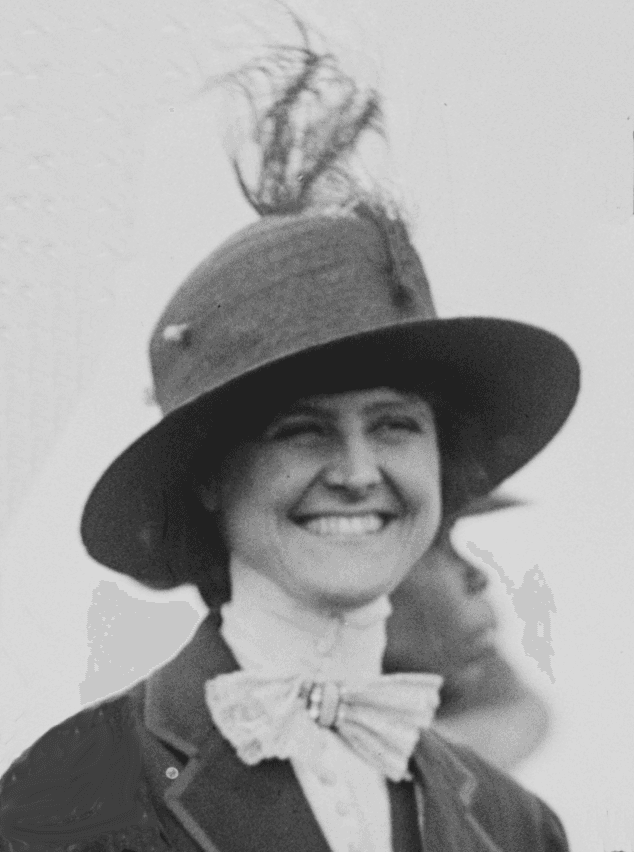
Aida de Acosta
1884–1962 · American (Cuban-Spanish heritage)
Early aviation (dirigible/airship piloting)
WHY YOU SHOULD KNOW THEM
First woman to solo-pilot any motorized aircraft (June 27, 1903) — a dirigible, predating the Wright Brothers' first powered flight by about six months
THEIR STORY
Aida de Acosta came from a prominent Cuban-Spanish-American family — her father, Ricardo de Acosta, was born in Cuba to Spanish parents — and grew up in the United States alongside sisters who became well-known writers, Mercedes de Acosta and Rita de Acosta Lydig. In 1903, while in Paris, she met Alberto Santos-Dumont, the Brazilian aviation pioneer profiled elsewhere in this app, who was already famous for his airship flights around the city. He gave her three flying lessons on his airship "No. 9," and then, remarkably, let her fly it completely solo from Paris to the Château de Bagatelle and back — a round trip of roughly ninety minutes. She landed partway through, in the middle of a polo match taking place below, with Santos-Dumont following her flight path on a bicycle from the ground. That flight, on June 27, 1903, made her the first woman ever to solo-pilot any motorized, powered aircraft — about six months before the Wright Brothers' first powered flight at Kitty Hawk. It's a genuinely remarkable historical first that most aviation histories simply omit, in large part because her aircraft was a steerable airship rather than a fixed-wing airplane. After only three lessons, she demonstrated real aircraft control — managing altitude, direction, and a mid-flight landing — with minimal training on one of the first personally pilotable powered aircraft ever built. Her life afterward moved in a completely different direction: diagnosed with glaucoma in 1922, she became a major philanthropist for eye health, raising three million dollars to help establish the Wilmer Eye Institute at Johns Hopkins University in 1925, and later ran the first eye bank in the United States, founded in 1945 — a second career with no connection to aviation, but with a comparably lasting impact.
WHAT THEY ACTUALLY DID
After only three lessons, de Acosta solo-piloted a powered, steerable airship across Paris and back — real, hands-on control of altitude, direction, and landing on one of the first personally flyable powered aircraft in history.
WHAT YOU'RE LEARNING THAT CONNECTS
Airship/dirigible flight relies on buoyancy for lift rather than the wing-generated aerodynamic lift covered in most aerodynamics lessons — a genuinely different flight principle worth understanding by contrast with fixed-wing aircraft.
DID YOU KNOW?
Her historic solo flight came after only three flying lessons.She later became a major medical philanthropist, helping establish the Wilmer Eye Institute at Johns Hopkins and running the first eye bank in the United States.
A NOTE ON HISTORICAL UNCERTAINTY
Her historic 1903 flight was aboard a dirigible (airship), not a fixed-wing aircraft — a real and important distinction from every other pilot profiled in this app. It's included here because it's a genuinely documented "first" in powered, piloted flight, but it should not be read as equivalent to fixed-wing flying.
SOURCES
Wikipedia
Photo: Bain News Service, publisher · Public domain · Source